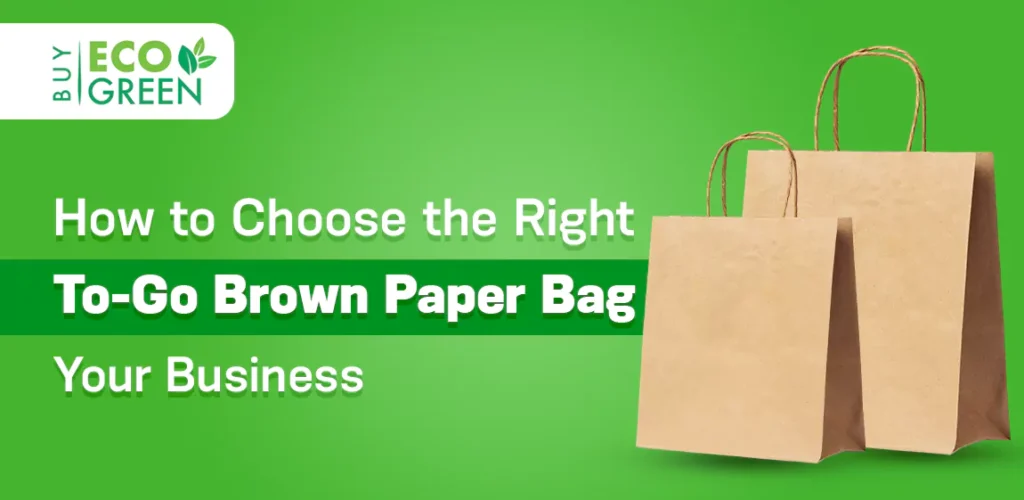
How to Choose the Right To-Go Brown Paper Bag for Your Business
Whether you run a school canteen, manage procurement for a council facility, operate a corporate café, or supply a community-based food service, the brown paper bag sitting on your counter is doing more work than you might realise. It carries your product, communicates your values, and leaves an impression long after the transaction ends.
Choosing the wrong bag creates real operational problems: bags that split under load, sizes that don’t fit your containers, materials that aren’t aligned with your organisation’s sustainability commitments, or packaging choices that fall short of local council or government procurement requirements.
This guide walks you through every factor worth considering, so the next time your organisation places a bulk order for to-go brown paper bags, you’re making a well-informed, environmentally responsible decision.
Why the Right Brown Paper Bag Matters More Than You Think
In a B2B context, packaging is a procurement decision, not just a convenience. For schools with canteens, government-operated food facilities, childcare centres serving snack packs, or businesses with busy café and grab-and-go counters, the paper bag you choose affects:
- Staff efficiency during service
- Food integrity during transit
- Environmental compliance and waste reporting
- Your organisation’s public-facing sustainability image
- Alignment with green procurement policies
A bag that tears, collapses, or can’t stand upright on its own leads to wasted product, frustrated staff, and dissatisfied customers. Equally, a bag sourced without regard for environmental standards undermines any sustainability commitment your organisation has made.
At Buyecogreen, we supply brown paper bags specifically suited to the operational demands of Australian institutions, businesses, and food service environments. Understanding what separates a good bag from the right bag starts with breaking down the key variables.
1. Understand the Size You Actually Need
Size is the most common source of errors when ordering paper bags in bulk. Too small and your containers won’t fit. Too large and bags slump, waste space, and present poorly at point of service.
Here’s a practical framework:
Small bags work well for single-item service: individual pastries, sandwiches, snack packs, or small bakery items. These are popular in school canteens and childcare centres where portioned snacks are distributed at scale.
Medium bags suit standard café and quick-service meal formats: a container plus a drink, or a couple of boxed items. These are the most frequently ordered size across office cafeterias and corporate food service.
Large bags are built for multi-item orders, family-sized meals, catering packs, or deliveries that include multiple containers. They’re commonly used in council-operated facilities, events catering, and food pantry distributions.
A key measurement to pay attention to is the gusset, which refers to the side expansion of the bag when open. A wider gusset means a bag can accommodate bulkier containers without straining at the seams. For organisations regularly packing square containers, meal boxes, or items with a wide base, the gusset width matters just as much as the bag’s overall height.
When ordering in volume, it’s worth trialling a small run first to confirm your containers, trays, and cups fit correctly before committing to a full pallet order.
2. Know Your GSM: Why Paper Weight Makes a Difference
GSM stands for grams per square metre, and it’s the standard measure of how thick and sturdy a paper bag is. Getting this right ensures your bags perform under real-world conditions.
For most food service and to-go applications, here’s a general guide to what different GSM ratings mean in practice:
70 to 90 GSM is suited to lighter loads such as single snacks, dry baked goods, or low-weight items. These work well for promotional pack-outs or canteen snack distributions where the bag doesn’t need to carry significant weight.
100 to 120 GSM is the workhorse range for standard food service. Strong enough to handle containers, small drink bottles, and multiple lighter items without tearing. This weight class is well suited to school canteens, café operations, and council food programs.
120 GSM and above is appropriate for heavier loads, multi-item orders, or situations where bags are carried over longer distances, such as outdoor catering events, market stalls operated by community groups, or bulk food pack distributions.
Buyecogreen’s to-go brown paper bags are manufactured from quality kraft paper, a material valued in commercial packaging for its natural strength and relatively low environmental processing footprint compared to bleached alternatives.
3. Handle Types and When Each One Works
The handle is often treated as an afterthought, but in a high-volume service environment it directly affects staff efficiency, carrying comfort, and bag integrity.
Twisted paper handles are the most widely used in food service and retail contexts. They provide a reliable grip, can carry moderate loads, and hold their shape well when bags are displayed or stacked at a service counter. They’re a good choice for school canteens, take-away-focused cafés, and office service operations.
Flat fold handles are folded paper strips attached to the inside top of the bag. They’re lighter, lower profile, and suited to lighter items. They work well for bakery bags, light snack packs, and environments where bags are stored compactly in large quantities.
Die-cut handles are integrated directly into the bag itself, with a cut-out opening near the top. These require no separate handle attachment, making them a durable and structurally simpler option. They’re particularly popular for deli-style service and food pack-outs in community and school settings.
No-handle SOS bags (self-opening sack style) are flat-bottomed bags designed to stand upright on their own without any handle at all. They’re ideal for school canteens, deli counters, and food service environments where bags are loaded quickly and handed directly to the recipient. Their self-standing design makes them easy for staff to fill without holding the bag open.
For organisations ordering across multiple service points or running events catering, it can be practical to stock more than one handle style to match the task.
4. Food-Safe and Compostable: Why These Credentials Matter for Institutions
Any brown paper bag used in direct food service needs to be food-safe. This means the materials, inks, and adhesives must be appropriate for contact with food items, including greasy or moist foods. For schools, childcare centres, and council-operated facilities, this isn’t optional. It’s a baseline requirement.
Beyond food safety, the environmental credentials of the bag matter significantly in an institutional procurement context. Many Australian organisations now operate under sustainability targets, green procurement frameworks, or commitments tied to climate action plans. Choosing packaging that contributes to those goals, rather than undermining them, is part of responsible operational management.
When evaluating brown paper bags for your organisation, look for:
Recycled content: Bags manufactured with post-consumer waste paper reduce demand for virgin timber resources and divert material from landfill. The proportion of recycled content can vary, and higher percentages generally reflect stronger environmental sourcing practices.
Compostability and biodegradability: Unlined kraft paper bags that are free from synthetic coatings will break down naturally in composting environments. For schools and businesses running food waste composting programs, this matters because it allows the bag and food scraps to be managed together in the same waste stream.
Recyclability: All kraft paper bags should be recyclable through kerbside paper recycling, provided they haven’t been contaminated beyond what the recycling facility accepts. Encouraging staff and customers to recycle used bags is a simple step that supports your organisation’s broader waste reduction commitments.
Responsible forestry certification: Look for bags sourced from paper certified under recognised frameworks that verify sustainable forest management practices. These certifications provide traceability and confirm that the raw material hasn’t been sourced through destructive logging.
At Buyecogreen, we are committed to supplying products that actively support our customers’ environmental goals, not just products that have surface-level green branding.
5. Ordering in Bulk: What Institutions Need to Plan For
For schools, councils, businesses, and community organisations ordering brown paper bags in volume, bulk purchasing offers clear advantages: consistent supply, less disruption to operations, and better stock management. But it also requires planning.
Here are the key practical considerations:
Standardise your sizes where possible. The more you can consolidate to one or two bag sizes, the simpler your ordering, storage, and staff training becomes. Conduct an audit of what you’re currently packing and find the size that covers the majority of your service needs.
Storage space is a real factor. Brown paper bags, particularly in large quantities, need dry, flat storage away from moisture. Bulk orders should be stored correctly to prevent bags from deteriorating before use.
Estimate usage accurately. Over-ordering wastes storage space and ties up procurement budget. Under-ordering means emergency purchases at short notice, which may not align with your sustainability procurement criteria. Track your usage across a representative service period before locking in a bulk order volume.
Plan for seasonal variation. School canteens, community food programs, and events-based operations all experience peaks and troughs in demand. Build that into your ordering schedule rather than responding reactively.
Buyecogreen supports organisations with reliable bulk supply of eco-friendly brown paper bags, making it straightforward to maintain consistent, sustainable packaging across your operations without scrambling for last-minute alternatives.
6. Aligning Your Packaging Choice with Your Sustainability Commitments
For many of Buyecogreen’s customers, sustainable procurement isn’t a marketing exercise. It’s tied to real targets: carbon reduction commitments, waste diversion goals, government reporting requirements, or community expectations.
Brown paper bags are one of the simplest packaging switches an organisation can make, but only when the product itself is genuinely eco-conscious. A bag labelled “natural” or “kraft” isn’t automatically sustainable. The source of the raw material, the manufacturing process, any coatings or laminates applied, and the end-of-life options all determine whether the bag is a genuinely responsible choice or simply a presentation decision.
The shift away from single-use plastic bags in food service is well established across Australia, and legislative pressure continues to grow at both state and federal levels. Choosing brown kraft paper alternatives that are compostable, recyclable, and made with recycled content positions your organisation ahead of compliance requirements rather than scrambling to meet them.
For organisations with formal sustainability reporting obligations, maintaining records of eco-certified product procurement, including packaging, supports transparent and credible environmental reporting.
7. Questions to Ask Before Placing Your Next Order
To make sure you’re selecting the right product for your context, run through these practical questions before finalising your order:
- What are we packing? How heavy, how bulky, how greasy or moist is the content?
- What size containers do we regularly use, and do we know their dimensions?
- How far is the bag being carried by the end user? Just across a counter, or some distance to a table, vehicle, or outdoor area?
- Do we have compostable waste management in place that would benefit from compostable bags?
- What is our expected weekly or monthly usage volume?
- Do we have adequate dry storage for bulk quantities?
- Does our procurement framework require certified sustainable packaging?
- Are we currently meeting our environmental reporting targets around packaging and waste?
Working through these questions makes the ordering process faster, reduces the likelihood of errors, and ensures the product you receive is genuinely fit for purpose.
Choosing Buyecogreen for Your Brown Paper Bag Supply
Buyecogreen exists to make sustainable procurement practical and accessible for Australian schools, councils, businesses, childcare centres, not-for-profit organisations, and community groups. Our to-go brown paper bags are part of a broader commitment to supplying products that help organisations reduce landfill waste, lower their environmental footprint, and procure responsibly.
We understand that institutions and businesses need reliable supply, straightforward ordering, and products that perform under real operational conditions. Every product in our range is selected with those needs in mind.
If you’d like to discuss the right brown paper bag option for your organisation’s specific requirements, or explore our full range of sustainable packaging and eco-friendly supplies, our team is ready to help.
Buyecogreen supplies eco-friendly, recycled, and compostable products to schools, government organisations, councils, businesses, and community groups across Australia. Explore our full sustainable packaging range to support your organisation’s greener procurement goals.
Frequently Asked Questions
What size brown paper bag is best for a school canteen or childcare centre?
For most school canteen and childcare food service operations, a small to medium bag works well for individual portions such as sandwiches, snack packs, and baked items. If your canteen regularly packs multiple items together or includes a drink alongside a meal, a medium bag with a wider gusset will give you the room you need without the bag straining at the sides. We recommend trialling a small quantity across your most common service formats before committing to a full bulk order. Buyecogreen’s team can help you identify the most suitable size based on what you’re regularly packing.
Are Buyecogreen’s brown paper bags suitable for greasy or moist food items?
Yes. Buyecogreen’s to-go brown paper bags are food-safe and made from kraft paper, which naturally handles moderate moisture and grease better than many lightweight paper alternatives. That said, for items with particularly high grease content, such as deep-fried foods or heavily sauced meals, we recommend placing food inside a suitable food-grade wrap or liner first before bagging. This maintains the bag’s structural integrity during service and keeps presentation looking professional, which matters when you’re running a high-volume operation.
Can our organisation include brown paper bag purchases in our sustainability reporting?
Absolutely. Switching to recycled, compostable, and biodegradable brown paper bags is a measurable step toward reducing your organisation’s packaging waste footprint, and it’s entirely appropriate to include this in sustainability or environmental reporting frameworks. Many councils, government departments, and educational institutions reference eco-certified procurement decisions in their annual environmental reporting. Buyecogreen can supply product information, including material composition and environmental credentials, to support your documentation and reporting requirements.
What is the difference between a compostable brown paper bag and a recyclable one, and does it matter for our waste management?
Both options are significantly better than plastic, but the distinction matters depending on how your organisation manages waste. A recyclable bag can go into your kerbside paper recycling stream once it’s no longer food-contaminated. A compostable bag, typically unlined kraft paper free from synthetic coatings, can go directly into a food organics composting stream along with food scraps, which is particularly useful for schools and facilities already running a FOGO (food organics and garden organics) program. If your site has composting infrastructure in place, choosing a certified compostable bag helps you make the most of that system and keeps more material out of general waste.
How do we calculate how many brown paper bags to order for a bulk purchase?
Start by tracking your current usage over a consistent service period, ideally two to four weeks, to get a reliable daily average. Multiply that figure by your preferred stock cover period, typically six to twelve weeks for most institutional buyers, and factor in any known peaks such as school events, council community days, or seasonal demand spikes. It’s also worth accounting for storage capacity, as bulk paper bag orders need dry, flat space away from moisture to stay in good condition. If you’re unsure where to start, Buyecogreen’s team is happy to work through the numbers with you and recommend an order volume that keeps your supply steady without overstocking.
Top Products
-
-

Recycled Paper Small Flat Gift Card Bag (Pack of 100)
$17.27 (incl. tax)
$15.70 (excl. tax) Add to cart -
-
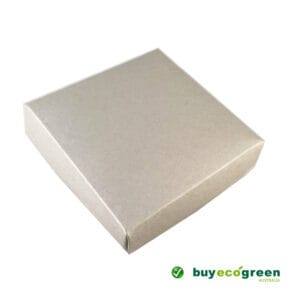
Recycled Gift Box (105mm square) – Silver and Natural Kraft (Pack of 5)
$14.90 (incl. tax)
$13.55 (excl. tax) Add to cart -
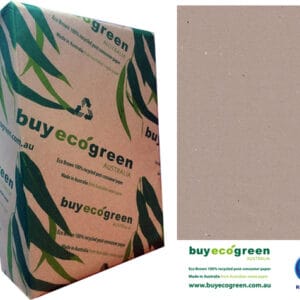
Eco Brown A4 110gsm 100% recycled paper (a Ream of 500 sheets)
$18.59 (incl. tax)
$16.90 (excl. tax) Add to cart -
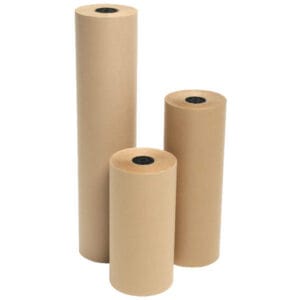
Recycled Brown Kraft Wrapping Paper Roll 65gsm, 450mm wide, 340m long
$95.25 (incl. tax)
$86.59 (excl. tax) Add to cart -
-