Bubble mailers vs. jiffy bags: Choosing the right padded mailer for shipping
Padded mailers protect documents, publications and smaller items in the post without the bulk of a box. The two formats organisations compare most often are bubble mailers, which use a plastic bubble lining for cushioning, and jiffy bags, which use a paper-fibre padding inside a kraft paper outer. For schools, councils, government departments, not-for-profits and businesses focused on recyclable packaging, the paper-based jiffy-style mailer is the more straightforward choice, because it can go into standard kerbside paper recycling.
What are padded mailers?
A padded mailer is a cushioned envelope built to absorb shock and vibration during transit, protecting the contents from the handling a parcel receives on its way through the postal network. The padding is what separates it from a plain envelope, and the material of that padding is where the main types of padded mailers differ.
There are two broad categories:
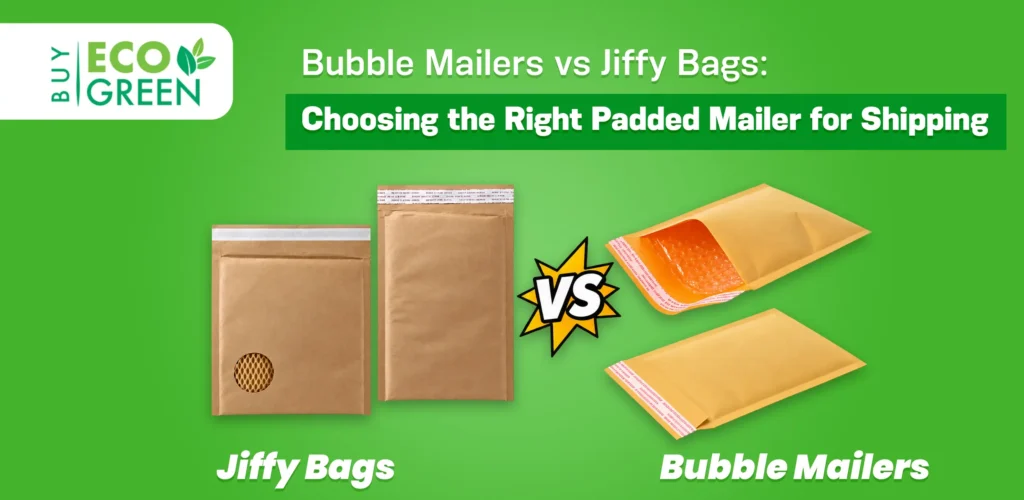
Bubble mailers, lined internally with plastic bubble wrap. The outer can be poly or paper, but the cushioning layer is plastic.
Jiffy bags (paper padded mailers), made with a kraft paper outer and padded inside with recycled paper fibre. The whole mailer is paper-based.
Understanding this material split is the starting point for any bubble mailers vs padded envelopes decision, because it determines both how the mailer performs and how it can be disposed of at the end of its life.
Bubble mailers vs jiffy bags: the key difference
The core of the jiffy bag vs bubble mailer question comes down to cushioning material and recyclability. Bubble mailers rely on a plastic bubble layer, which makes them light and moisture-resistant but creates a mixed-material product that is difficult to recycle through household paper streams. Jiffy-style paper padded mailers use paper fibre for cushioning, so the entire mailer stays within one recycling stream.
Feature
Bubble mailer
Jiffy bag (paper padded mailer)
Cushioning
Plastic bubble lining
Recycled paper fibre
Outer material
Poly or paper
Kraft paper
Weight
Very light
Light
Moisture resistance
High
Moderate
Recyclability
Difficult, mixed material
Kerbside paper recycling
Best suited to
Non-fragile items where a plastic layer is acceptable
Documents, books, and organisations reducing plastic
For most institutional dispatch, the recyclability column is the deciding factor. A paper padded mailer keeps packaging within a single, widely accepted recycling stream, which is far easier to document for procurement and sustainability reporting than a plastic-lined alternative.
Which padded mailer is better for the environment?
Plastic bubble linings are the weak point in conventional mailers. Because the plastic is bonded to the outer, the two materials cannot be separated easily, so the mailer usually ends up in general waste. That works against any organisation trying to reduce landfill and plastic use.
Paper padded mailers avoid this. Made from recycled paper and padded with paper fibre, they break down naturally and are recyclable through the same kerbside collection as office paper and cardboard. Buyecogreen’s eco-friendly padded bags and sustainable mailers are built on recycled paper for exactly this reason, giving warehouses, offices, councils and fulfilment teams a mailer that supports responsible procurement without a change in workflow. The same principle runs through the wider 100% recycled paper range, sourced from Australian post-consumer waste.
Best padded mailers for shipping: how to choose
The best padded mailers for shipping depend on what is inside and how much protection it needs. A few practical guidelines help match the format to the job:
Documents, certificates and reports: a lightweight paper padded mailer protects against creasing and light knocks while keeping postage low.
Books, catalogues and printed resources: a stronger kraft outer resists tearing and holds its shape under repeated handling.
Semi-fragile items: add a layer of GreenWrap paper cushioning, a paper-based replacement for plastic bubble wrap that expands to wrap items snugly.
Loose or awkward-shaped contents: fill remaining space with shredded recycled paper so items sit securely inside the mailer.
Sealing matters too. Finishing a paper mailer with kraft paper tape instead of plastic tape keeps the whole parcel recyclable in one stream, which is the detail that makes a sustainability claim hold up.
Buying padded mailers in bulk
For organisations dispatching regularly, ordering bulk padded mailers keeps supply consistent and unit handling simple. Standardising on a small core set of sizes rather than many one-off products makes reordering predictable and keeps storage tidy.
Buyers looking to buy bubble mailers for everyday shipping increasingly compare them against paper-based padded mailers as single-use plastic rules widen across Australian states and territories. Choosing paper padded mailers Australia-wide from one supplier also reduces freight from multiple accounts and gives procurement teams material claims they can stand behind. For a fuller picture of how mailers fit alongside void fill, cushioning and boxes, our guide to sustainable packaging choices sets out how the pieces work together as one system.
Frequently asked questions
What is the difference between a bubble mailer and a jiffy bag?
A bubble mailer is padded with a plastic bubble lining, while a jiffy bag uses recycled paper fibre inside a kraft paper outer. The jiffy bag is fully paper-based and easier to recycle.
Are padded mailers recyclable?
Paper padded mailers are recyclable through standard kerbside paper collection. Plastic-lined bubble mailers are harder to recycle because the plastic and paper cannot be separated easily.
Which padded mailer is best for shipping documents?
A lightweight paper padded mailer suits documents, certificates and reports, protecting against creasing while keeping postage low. Heavier kraft mailers are better for books and catalogues.
Can I buy padded mailers in bulk for my organisation?
Yes. Buyecogreen supplies bulk padded mailers in a range of sizes to schools, councils, businesses and not-for-profits across Australia, with consistent stock for regular dispatch.
Do I still need extra cushioning inside a padded mailer?
For semi-fragile items, yes. A layer of paper-based GreenWrap or shredded recycled paper inside the mailer adds protection while keeping the whole parcel recyclable.
Order padded mailers for your organisation
Move your dispatch to recyclable, paper-based padded mailers that protect your items and support your environmental commitments. To order bulk padded mailers or discuss the right sizes for your shipping, contact the Buyecogreen team on 1300 663 488 or email info@buyecogreen.com.au.