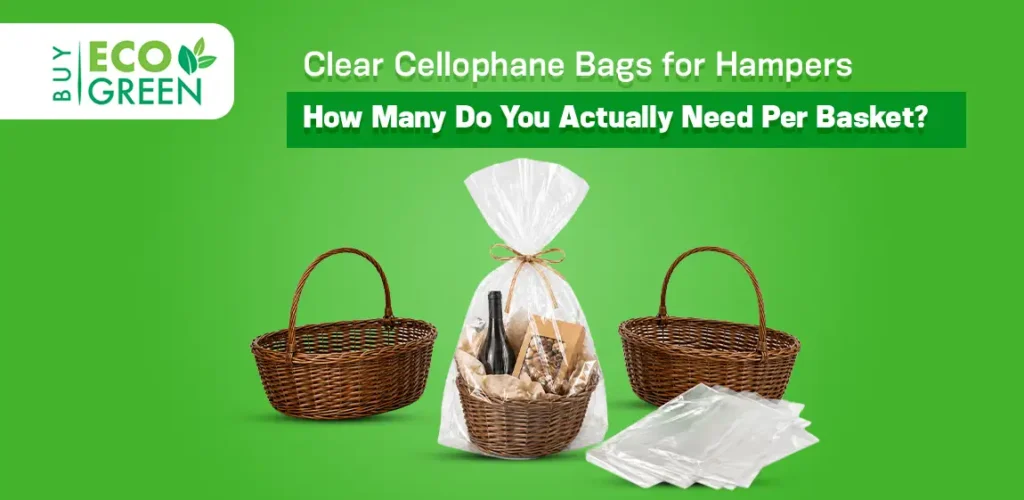
Most guides on wrapping a hamper answer a different question from the one procurement teams are asking. They show you how to wrap a single basket at home, usually with a heat gun and a lot of trial and error. That is little help when you are ordering supplies for fifty fundraiser hampers, two hundred staff appreciation baskets or a season of client gifts, and you need to know how much to buy before the job starts.
The question that matters for a bulk order is simpler and more useful: how much cellophane does one hamper actually use, and how does that scale across a full run? Once you can answer that per basket, the order quantity works itself out. The part almost every guide misses is that a hamper uses cellophane in two separate places, and each is planned differently.
The two layers of cellophane in a hamper
The outer layer is the sheet or length of film that goes around the whole basket and gathers at the top. This is the one people picture when they think of a wrapped hamper.
The inner layer is the set of smaller bags that wrap individual items inside the basket, the biscuits, lollies, small treats or loose products that need to stay contained and presentable before the whole thing is wrapped. Not every hamper needs inner bags, but most food or mixed hampers do, and they are easy to forget when you are only counting outer sheets.
Plan the two layers as separate line items on your order, and the quantities will stop being guesswork. Both come from the same cellophane bags and sheets range, so a single order covers the lot.
Working out the outer wrap per basket
The outer wrap needs to reach up both sides of the basket and leave enough film above the top to gather and tie. A reliable way to size it is to take the width of the basket, add twice its height, then add a gather allowance of around 30 to 40cm so there is plenty to bunch at the top. Do the same for the length. That gives you the sheet size one basket needs.
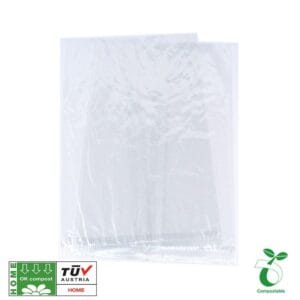
For most small and medium hampers, a single large clear cellophane sheet in the region of 750 x 1000mm covers the job comfortably. The clear sheets and gusseted formats are made for exactly this kind of wrapping and display work. As a rough per-basket starting point:
- Small hamper, up to about 25cm across, such as a shoebox-sized basket: one large clear sheet, or roughly 1 metre off a clear cellophane roll.
- Medium hamper, around 30 to 40cm: one large clear sheet, or about 1.2 to 1.5 metres off the roll.
- Large hamper, 40cm and above: two sheets, or around 1.5 to 2 metres off the roll, sometimes overlapped for full side coverage.
One point on the roll worth noting for planning: it is 500mm wide, so it suits smaller or narrower baskets and custom lengths. For wide baskets, large sheets give better side-to-side coverage than the roll.
Sheets or a roll: which suits your run
Sheets and rolls both work, and the better choice depends on how consistent your hampers are. If every basket in the run is the same size, sheets are faster, because there is nothing to measure and cut. You pull one sheet per hamper and wrap. If your baskets vary in size, or you are wrapping oddly shaped contents, the roll lets you cut each length to fit and waste less film.
A practical approach for a mixed run is to use sheets for the standard baskets and keep a roll on hand for the outliers.
Working out the inner bags per basket
Inner bags are counted by contents, not by basket size. Go through what is going into a typical hamper and count the items that benefit from being bagged individually. For most food or mixed hampers that land somewhere between two and five bags per basket, so around three to four is a sensible planning figure to start from.
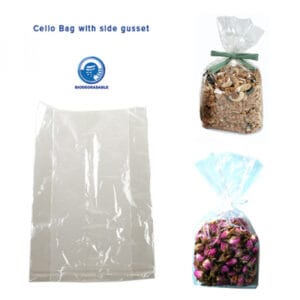
Match the bag format to the item. Flat bags suit slim contents like biscuits, cards or bars. Gusseted bags, which expand at the base to stand upright, suit items with height or bulk such as jars, small bottles and baked goods. The gusseted bags in a box of 1000 are a common choice for hamper components, while smaller flat and card-sleeve bags in packs of 100 cover lighter items. If you are unsure which sizes match your contents, the cellophane gift bag sizing guide walks through it in detail.
Scaling to a batch order
Once you have a per-basket figure for each layer, multiply out and round to the pack sizes on offer. Clear and coloured sheets come in packs of 25, and bags come in packs of 100 or boxes of 1000. A worked example for 50 medium hampers, each using one outer sheet and four inner bags:
- Outer wrap: 50 sheets, which rounds up to two packs of 25.
- Inner bags: 200 bags, which is two packs of 100, or a box of 1000 if you run hamper batches through the year and want the lower per-unit cost.
Add roughly 10 per cent on top of both figures. That spare covers practice wraps, the odd tear and any hampers that turn out larger than the standard. Running short mid-batch is the one thing worth avoiding, and the buffer is small.
Why genuine cellulose matters for hamper runs
Most clear film sold in Australia as cellophane is actually BOPP, a petroleum-based plastic that does not biodegrade and cannot go in kerbside recycling. Buyecogreen stocks genuine plant-based cellulose cellophane, which biodegrades like paper. A quick check tells them apart: real cellophane tears cleanly by hand, while plastic film stretches and resists tearing. There is more on that distinction in our piece on cellophane facts and myths.
For a hamper run, genuine cellulose has a practical advantage beyond the environmental one. It holds a crease and keeps a gathered shape on its own, which means staff or volunteers can wrap and tie by hand with no heat gun. The consumer guides that call for a heat gun are working around plastic film, and that step disappears with real cellophane. For a school fete, a council event or a community group, that makes volume wrapping simpler and safer, and keeps the packaging consistent with the environmental message of the event.
Finishing and complementary products
A complete hamper setup usually needs a few things alongside the cellophane. Shredded paper fills the base and cushions contents, tissue paper lines the basket and pads individual items, and natural finishing materials close the wrap. For ties and bows, the range covers twine, raffia and swing tags, hemp cord and twines and jute or burlap ribbon. To seal without introducing plastic tape, biodegradable sticky tape keeps the whole presentation plastic-free. For a structured alternative to a basket, recycled gift boxes and cotton and jute gift bags work well, too. Ordering these together with your cellophane means the full run comes from one supplier.
Frequently asked questions
How many cellophane sheets do I need per hamper?
For most small and medium hampers, one large clear sheet wraps the whole basket. Larger baskets usually need two. Count one outer sheet per standard hamper, then add the inner bags separately based on the contents.
Should I buy sheets or a roll for wrapping hampers?
Use sheets when every basket is the same size, as there is nothing to measure or cut. Use the clear cellophane roll when baskets vary and you want to cut each length to fit and reduce waste.
How many bags go inside a hamper?
It depends on the contents, not the basket size. Count the items worth wrapping individually, usually two to five per hamper. Around three to four bags per basket is a good figure to plan a batch order from.
Do I need a heat gun to wrap hampers in cellophane?
No. Genuine cellulose cellophane holds a gathered fold on its own, so you can wrap and tie by hand with twine, ribbon or biodegradable tape. Heat guns are only needed for plastic shrink films.
Do you supply cellophane in bulk to schools, councils and businesses?
Yes. Buyecogreen supplies genuine cellulose cellophane sheets, rolls and bags Australia-wide in packs and bulk boxes. For quantities to match your run, call 1300 663 488 or email info@buyecogreen.com.au.
Order cellophane for your next hamper run
If your school, council, community group or business is planning a batch of hampers, working out the two layers per basket first makes the order straightforward. To match sheet sizes, roll lengths and bag formats to your run, or to arrange a bulk order, call the Buyecogreen team on 1300 663 488 or email info@buyecogreen.com.au. We supply genuine cellulose cellophane Australia-wide, with dependable stock and straightforward bulk ordering.