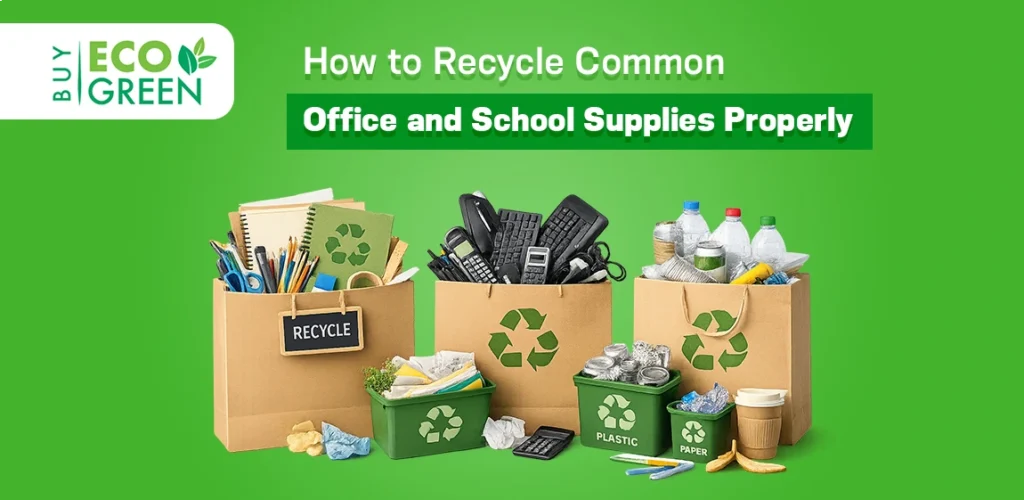
Most office and school supplies can be recycled, but only if two things happen. The item needs to reach the right recycling stream, and it needs to be made from a material that Australian recycling systems can actually process. Recycled paper, card, envelopes and manilla folders go in the paper recycling stream. Pens, markers, plastic-laminated folders and mixed-material items usually cannot go in kerbside recycling at all, and end up in landfill unless a specialist collection is used.
That second point is where most recycling guides stop short. What your organisation can recycle at end of life is decided at the purchasing stage, months earlier. A school that buys plastic-coated exercise books has already committed that cover to landfill. A council office that stocks eco friendly office supplies made from recycled paper, card and compostable materials has already done most of the recycling work before a single item is used.
This guide covers both halves: how to dispose of common supplies correctly, and how procurement teams can choose products that keep materials in circulation.
Why recycling start with what you buy?
Australian kerbside and commercial recycling handles paper and cardboard very well. It handles mixed materials poorly. A recycled paper notepad is a single material and recycles cleanly. A notepad with a plastic spiral binding and laminated cover is three materials fused together, and most recovery facilities will reject it or send it to landfill.
For schools, councils, government departments and businesses, this has a practical consequence. The simplest way to lift your organisation’s recycling rate is to standardise on mono-material, recycled-content products. Buyecogreen’s range of environmentally friendly stationery is built around this principle, with products made from recycled paper, FSC-certified timber, sustainable bamboo and biodegradable cornstarch rather than fused plastics.
Paper, copy paper and card
Office paper is the easiest win. Used copy paper, printed documents, letterheads and card offcuts all belong in the paper recycling stream. Keep paper dry and free of food contamination, and remove any plastic sleeves before binning. Staples and paper clips in small quantities are fine, as recovery mills remove them during pulping.
Shredded paper is a partial exception. The short fibres are harder to recover, so check whether your commercial recycling contractor accepts it loose or requires it contained.
Closing the loop matters just as much as correct disposal. When your organisation prints on 100 per cent post-consumer recycled stock, it creates demand for the very paper it puts in the recycling bin. Buyecogreen’s recycled paper and card range is made from post-consumer waste, FSC certified and Process Chlorine Free, which gives procurement teams verifiable credentials for sustainability reporting.
Cardboard and packaging
Flatten boxes, keep them dry and place them in the paper and cardboard stream. Waxed or plastic-laminated board cannot be recycled through standard collections. Cardboard deserves its own detailed treatment, and we have covered the types of cardboard, what each one is made from and how the Australian recycling process works in our full cardboard recycling guide.
Envelopes, folders and filing products
Plain paper envelopes recycle without any preparation. Window-faced envelopes are accepted by most Australian paper streams, though removing the film first is best practice for high-volume mailrooms.
Filing products are where organisations lose the most recyclable material. Manilla folders, kraft document wallets and recycled board presentation folders all recycle in the paper stream once metal fittings are removed. PVC document wallets, plastic display books and vinyl-covered binders do not. They sit in landfill for decades after a working life that might last one financial year.
The fix sits with purchasing, not the bin room. Buyecogreen’s recycled files and folders are made from post-consumer recycled board, so the same folder that organises your documents this year can re-enter the paper stream when its job is done.
Pens, markers and writing instruments
Conventional plastic pens cannot go in kerbside recycling. The barrels are too small for sorting machinery and combine several plastics with metal and ink components. Specialist writing instrument collection programs operate across Australia, and organisations with large volumes can arrange dedicated collection boxes through commercial recyclers.
A better long-term approach is to reduce the plastic entering your organisation in the first place. Biodegradable pens made from cornstarch break down in composting environments rather than persisting in landfill, and recycled paper pen barrels are compostable at end of life. Buyecogreen’s full eco pens range also includes recycled plastic, sustainable bamboo and FSC-certified timber options, so schools and offices can match the writing instrument to their waste streams. FSC-certified wooden pencils simply sharpen down to almost nothing, with shavings suitable for compost.
Notepads, sticky notes and exercise books
Recycled paper notepads and adhesive notes recycle in the paper stream, adhesive strip included. The volumes are small per item but large per organisation, so make sure staff room and classroom bins capture them. Spiral-bound books need the metal or plastic coil removed first. Exercise books with plastic vinyl covers need the cover stripped before the paper pages can be recycled, which is exactly the kind of extra step that stops recycling happening in busy schools.
Buying mono-material notepads made from recycled paper removes that friction entirely. For classroom supplies more broadly, Buyecogreen’s eco-friendly school supplies range gives schools and childcare centres recyclable and compostable alternatives across booklist staples.
Setting up recycling streams that staff actually use
Correct disposal fails when it depends on individual effort. A few structural steps make it reliable across an organisation:
Place paper recycling bins at every desk cluster, printer and classroom, with general waste bins deliberately less convenient. Add a single clearly labelled collection point for items that need specialist recycling, such as pens and markers. Brief cleaning contractors so sorted streams are not recombined. Review what shows up in general waste each term or quarter, then adjust purchasing to remove the unrecyclable items appearing most often.
That last step is the one most organisations skip, and it is where sustainable office solutions deliver measurable results. If laminated folders keep appearing in landfill audits, the answer is to stop buying laminated folders.
Choosing supplies that make recycling easy
The pattern across every category above is the same. Single-material products made from recycled or plant-based content recycle or compost readily. Mixed-material products made from virgin plastic do not, regardless of how carefully staff sort them.
For procurement teams, this turns supplier selection into an environmental decision. Standardising on recycled stationery and sustainable stationery across paper, filing, writing and classroom categories means every subsequent purchase supports your organisation’s waste reduction targets without any additional policy work. It also gives sustainability officers clean data for reporting, since recycled content percentages and certifications such as FSC are documented on each product.
Buyecogreen supplies Australian-made eco-friendly stationery and office products in bulk quantities to schools, councils, government departments, childcare centres, not-for-profits and businesses nationwide. To set up bulk ordering for your organisation or discuss which products suit your recycling streams, call the team on 1300 663 488 or email info@buyecogreen.com.au.
Frequently Asked Questions
Can pens and markers go in the kerbside recycling bin?
No. Pens and markers are too small for sorting machinery and contain mixed plastics, metal and ink. Use a specialist writing instrument collection program, or switch to biodegradable cornstarch or recycled paper pens that compost at end of life.
Are sticky notes and notepads recyclable in Australia?
Yes. Recycled paper notepads and adhesive notes go in the paper recycling stream, adhesive strip and all. Remove any plastic spiral binding from spiral notepads first so the paper pages recycle cleanly.
Do staples need to be removed before recycling paper?
No. Small quantities of staples and paper clips are removed during the pulping process at recovery mills. Focus instead on keeping paper dry, clean and free of plastic sleeves or laminated sheets.
What office supplies cannot be recycled?
PVC document wallets, laminated folders, plastic-coated exercise book covers and mixed-material items are the main culprits. Replacing them with recycled document wallets and board-based filing products keeps those materials in the paper stream instead of landfill.
How can our organisation improve its stationery recycling rate?
Buy mono-material products made from recycled content, so items recycle without preparation. Then place paper recycling bins at every workpoint, add one collection point for specialist items, and review landfill audits to remove unrecyclable products from future orders.